 Seven2Offsuit
The Expensive Call
Sir Neverfold: "A good knight never backs down."
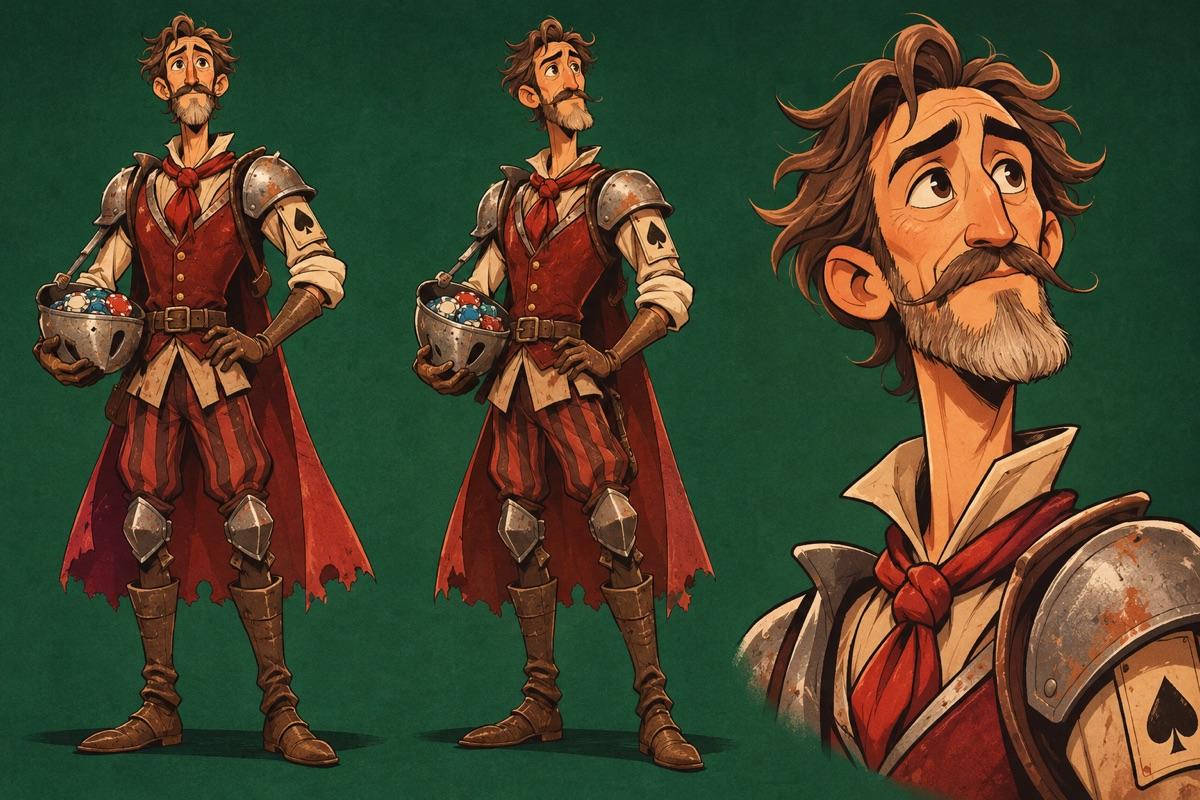
The spot
It is the river. Sir Neverfold holds K♦ 9♣ on a board of K♠ 8♦ 5♣ 3♥ 2♠. The pot is 100. A quiet merchant, who has barely bluffed all night, bets 100.
Call 100 to win 200, or fold?
What happened
Sir Neverfold called. The merchant turned over K♥ Q♣ and took the pot.
The math
- Price: call 100 to win 200
- Equity needed to break even: 33.3%
- Sir Neverfold's equity against the assumed range (44 combinations): 18.2%
- Expected value of calling: -45.45
Assumptions
- The merchant bets A-K, K-Q, the sets 88, 55, 33 and 22, and the straights 6-4 suited and A-4 suited for value, and bluffs with Q-J suited and J-T suited. Thinner kings such as K-J and K-T are left out because a tight player is unlikely to bet them for pot size.
- This is a simplification: every listed hand bets equally often, and combinations that share a card with the board or Sir Neverfold's hand are removed.
- Equity is exact: every hand in the range is run against Sir Neverfold's hand on the final board, with ties counted as half a win. There are no cards left to come.
- Calling breaks even only if the merchant bluffs about a third of the time. In this range 18.2% of the hands are bluffs, and this player had not bluffed all night. If you believe the merchant bluffs far more, calling can become profitable.
- A decision is judged by its expected value when it is made, not by the hand the merchant happened to show.
Lesson: A call has to earn back what it costs. Pride is not equity.
Open in the pot odds calculatorShare this spot
Characters and stories are original. Each episode is one reasonable reading of one spot, not the only correct play.