 Seven2Offsuit
The Sunk-Cost Trap
Sir Neverfold: "A good knight never backs down."
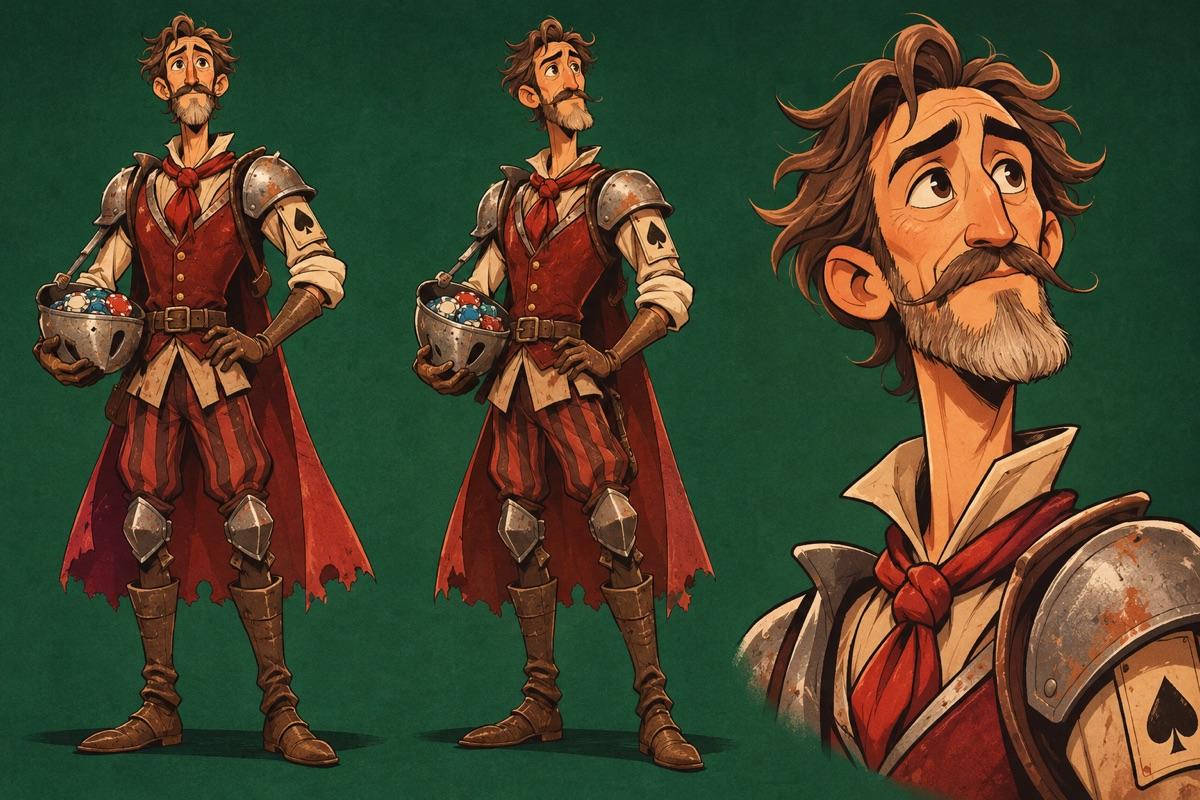
The spot
It is the turn. Sir Neverfold holds A♣ 7♣ on a board of K♣ 8♣ 3♦ 2♠. The pot is 100, and 60 of it is his own money from earlier streets. The merchant bets 100.
Call 100 to win 200, or fold?
What happened
Sir Neverfold called: "I have too much in to fold now." The river was the 5♦. The merchant turned over A♦ K♥ and took the pot.
The math
- Price: call 100 to win 200
- Equity needed to break even: 33.3%
- Sir Neverfold's equity against the assumed range (48 combinations): 22.4%
- Expected value of calling: -32.67
Assumptions
- The merchant bets A-K, K-Q, K-J, the pairs AA, KK, 88, 33 and 22 for value, and has no bluffs in this range. He is tight and had not bluffed all night. Ranges are estimates: add ten club-draw combinations such as Q♣ J♣ and Sir Neverfold's equity rises to 33.5%, enough to call.
- This is a simplification: every listed hand bets equally often, and combinations that share a card with the board or Sir Neverfold's hand are removed.
- Equity is exact: every hand in the range is run against Sir Neverfold's hand on every possible river card, with ties counted as half a win.
- The 60 chips he already put in are gone whether he calls or folds. They still sit in the pot he could win, which sets the price, but only the 100 to call is new money.
- This ignores money won or lost after the river. If you expect a much bigger pot when the flush comes in, the implied odds calculator shows how much more he would need.
Lesson: Chips already in the pot are gone. Only the price of the call and what it can win matter.
Open in the pot odds calculatorShare this spot
Characters and stories are original. Each episode is one reasonable reading of one spot, not the only correct play.