 Seven2Offsuit
The Perfect Fold
Sir Neverfold: "A good knight never backs down."
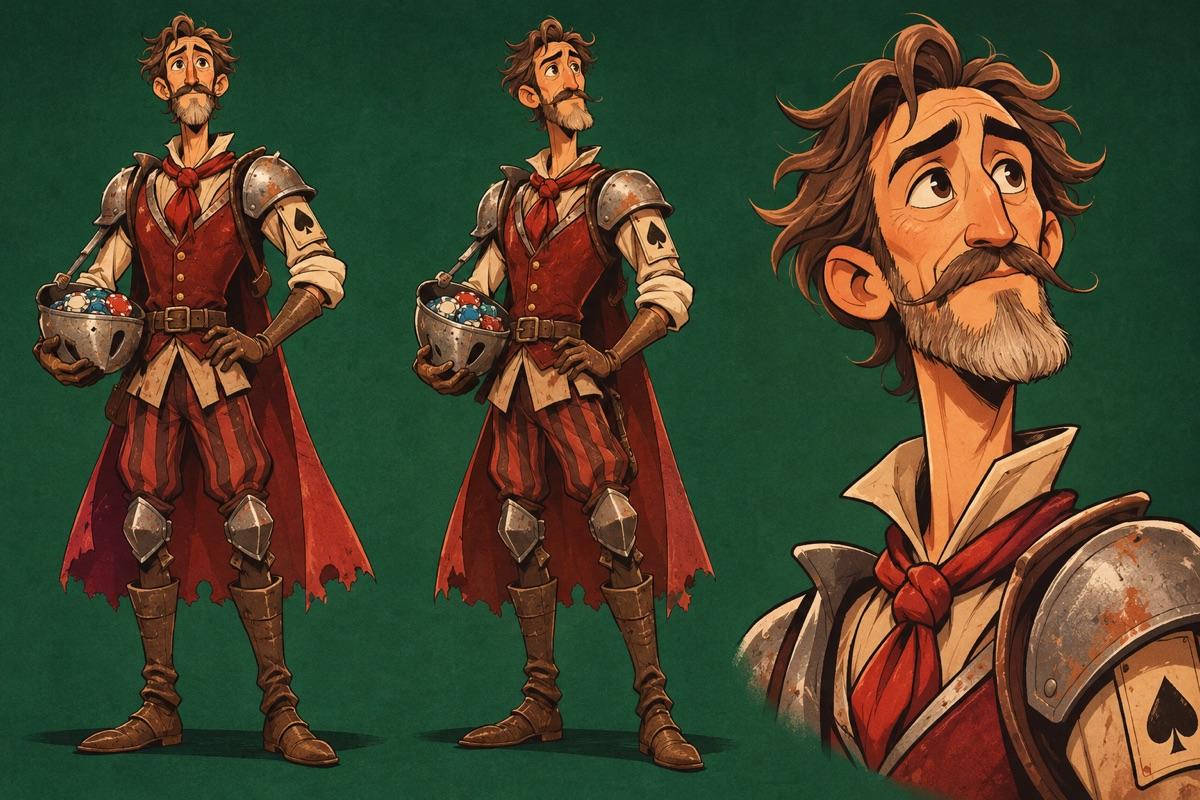
The spot
It is the river. Sir Neverfold holds Q♠ Q♦ on a board of 9♦ 8♣ 7♠ 2♦ 3♥. The pot is 120. The merchant bets 120.
Call 120 to win 240, or fold?
What happened
Sir Neverfold folded without a speech. The merchant turned over J♥ T♠ and showed the straight. The knight kept his stack for the next battle.
The math
- Price: call 120 to win 240
- Equity needed to break even: 33.3%
- Sir Neverfold's equity against the assumed range (75 combinations): 21.3%
- Expected value of calling: -43.2
Assumptions
- The merchant bets the straights J-T, T-6 and 6-5, the sets 99, 88 and 77, and the two pair 9-8 suited for value, and bluffs with A-K. He is tight, and A-K is the only missed hand he bets.
- This is a simplification: every listed hand bets equally often, and combinations that share a card with the board or Sir Neverfold's hand are removed.
- Equity is exact: every hand in the range is run against Sir Neverfold's hand on the final board, with ties counted as half a win. There are no cards left to come.
- Sir Neverfold's queens beat only the A-K bluffs. A hand that is strong on a dry board can be weak on a connected one. If the merchant bluffs more often than A-K alone, calling gets closer; it takes about 14 more bluff combinations to break even.
- A decision is judged by its expected value when it is made, not by the hand the merchant happened to show.
Lesson: Folding is not retreat. It keeps the chips for the next fight.
Open in the pot odds calculatorShare this spot
Characters and stories are original. Each episode is one reasonable reading of one spot, not the only correct play.